


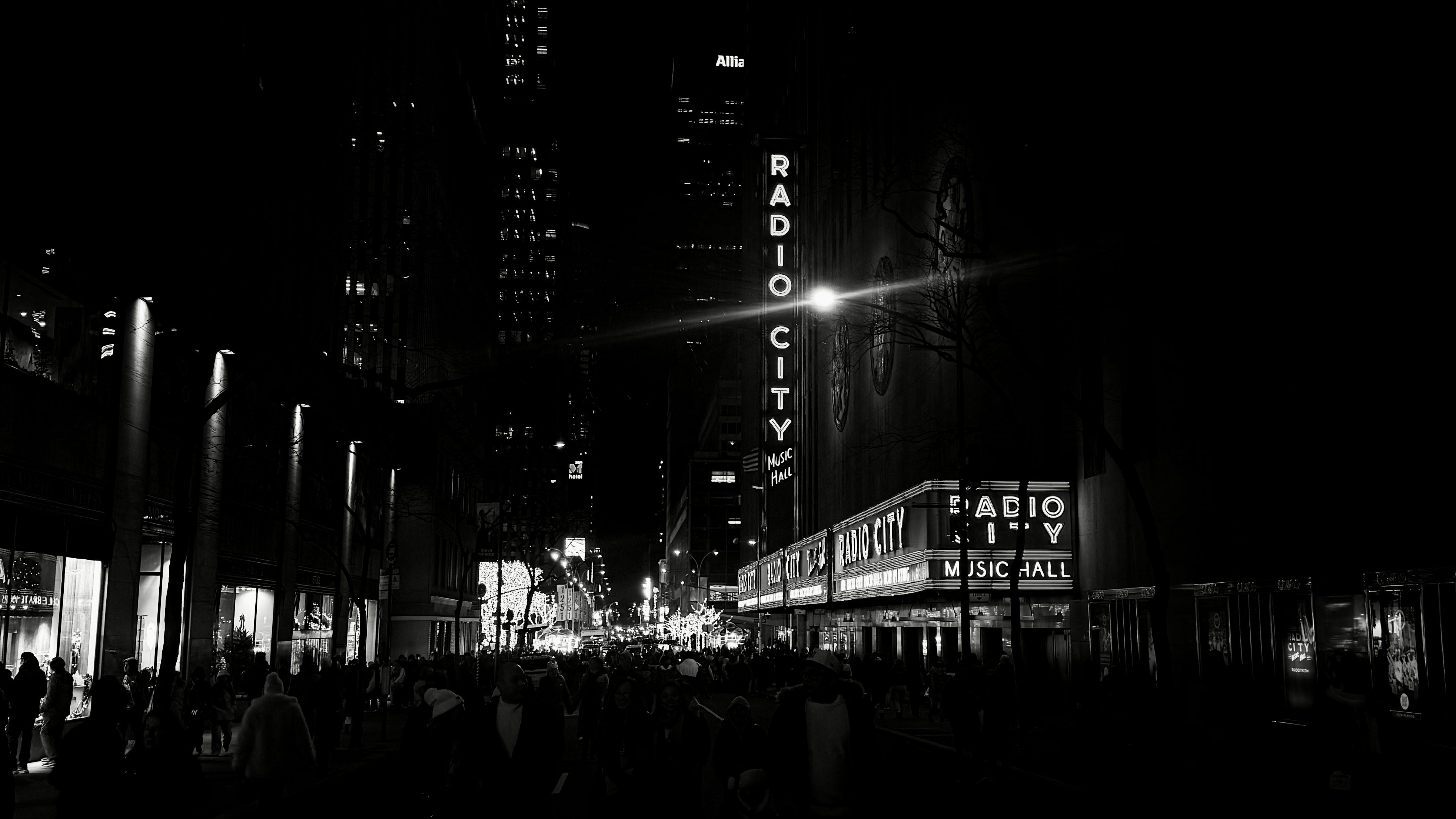
On July 16, 1986, forty years ago to the day, the nineteen-year-old version of me, from nowhere-special North Carolina, stepped off a Piedmont Airlines jet (remember them?) carrying a duffel bag, a saxophone, three hundred dollars in his pocket, and an acceptance letter to the Jazz and Contemporary Music Program at The New School. He stepped straight into an adventure that continues to this day.
The decision to move to New York had actually been made a couple of years earlier, although I wasn’t fully aware of it at the time. There’s a peculiar place where youth and ignorance intersect: you have absolutely no idea what you’re getting yourself into, and you’re young enough to be fearless. Or stupid. Or both.
In my case... definitely both.
But first, a little backstory, just so you can be completely aware of the recurring themes that have been a thread throughout my life.
By the time I was a junior in high school, I knew that I wanted to make my life in music and specifically playing the saxophone. So I fatefully one day decided to audition for the local conservatory at the University of North Carolina at Greensboro so that I could get a critique of my playing and know what I needed to work on, so that when I auditioned for real the following year, I might be able to prepare myself better for the experience.
I went in and did the audition, and at the end of the audition, the teaching assistant said, “The dean would like to meet with you.” I thought to myself, “Oh great, what have I done now?” lol. I walked in, sat down across from the dean, and he looked at me and said, “How would you like to come to school THIS year?” My immediate response was, where do I sign?! So a long story cut short, I left high school (in actuality, I had to quit school and drop out) at the end of my junior year and enrolled at the university as a freshman saxophone major. This would have been the fall of 1984.
It was within this first semester that I met my teacher, Neill Clegg. Neill has gone on to become one of my dearest friends and has been an advisor, mentor, confidant and sounding board. My first encounter with Neill, however, was less than wonderful for either of us!
For my first lesson with Neill, I met him in his studio on Mendenhall Street. I walked in all full of piss and vinegar because I was the hotshot kid from my high school, and I had just, of course, skipped over a year of school to come to college. So man, I must really have it together! Ha!
So I walk in and Neill says to me, “Get out your horn and play a little bit.” So I pull my horn out and I begin to blaze through all of my licks and all of this great stuff that I had learned, which in hindsight was actually pretty pathetic. Ah, ignorance, my old friend.
I stop playing, I turn around, and Neil is sitting behind his desk with his head buried in his hands. He peers at me over the top of his hands and says in a dry, NY infused, deadpan voice, “You have got to be the worst saxophone player I’ve ever heard. Let’s start from there.”
Oh boy. Let the games begin!
In retrospect, I of course understand what Neill was doing. He was following the classic playbook of tearing something down so that it could be built up stronger. Of course at the time, I had no idea that’s what was going on. I was just pissed that somebody thought I wasn’t brilliant! And my entire mission in life from that point on was to prove him wrong... But to my credit, I began to work my butt off.
As I’ve learned from being on both sides of that equation, the only time that happens is when someone believes in you. So Neill, with all of my heart and all of my love, thank you for believing in me. None of this would have been possible without you. In other words, it’s all your fault!
While I was a student with Neill, I spent countless hours listening to stories about the city and its inhabitants. Neill had lived for several years in New York before joining the faculty at UNCG. He would constantly tell me, “If you want to find out whether you have what it takes to be who you say you want to be, you need to be somewhere else. And New York is where you need to go.”
That was a daunting idea for a small-town kid who was still trying to figure out where he fit in the world.
Sometime during the late fall of 1984, or maybe the spring of 1985–definitely the middle of my first year of college; memory gets a little fuzzy after forty years. I found myself standing near the old TKTS booth in Times Square.
I was scared. Completely, utterly scared shitless. Quite literally shaking in my shoes. And yet I’d never felt more alive.
More importantly, I’d never been more certain that I belonged anywhere in the world than I did standing there in that moment. For me, that realization was nothing short of revelatory. I suddenly understood what had been missing my entire life.
I’d never felt like I belonged growing up. For reasons too complicated to unpack here, I never really felt accepted. I never felt like I fit. I was, in every sense, a displaced soul.
But New York... New York was it. I’d finally found my home. I’d finally found my tribe.
Now, you have to remember, this was before the sanitation and Disneyfication of Times Square. There were crack addicts and prostitutes everywhere. Trash lined the sidewalks. Every ten feet there seemed to be another peep show, porn palace, or massage parlor.
Man, New York had style back then. Grit. Character. In spades.
It bore absolutely no resemblance to the Banana Republic, J. Crew, Applebee’s version of itself it pretends to today. I miss that city.
Anyway, there I was, a kid from a tiny Southern town who had never experienced anything remotely like this. It was terrifying. And I have never felt more alive than I did during those first few days wandering through the city that would eventually become my home.
I went back to North Carolina knowing, with absolute certainty, that I would someday live in New York. I had no idea how. No idea when. No idea whether I could actually pull it off. I just knew this was where I belonged.
Over the next several months I went back out on the road, touring the Southeast with a chitlin’-circuit lounge band, playing one-nighters up and down the East Coast. Then one day I spotted an advertisement for The New School. They were recruiting students for a brand-new jazz program.
I’d found my way into the madness.
One of my first experiences in New York came maybe two weeks after I arrived. I remember thinking to myself, I’m going to go to a jam session.
There was one happening on Eighth Avenue, somewhere in the upper 30s if memory serves.
Picture the scene:
A large, smoke-filled box of a room with a stage at one end opposite the front door. A tired rhythm section plowing through standard after standard after standard. Along one wall stood what seemed like an endless line of horn players, waiting their turn to be shuttled onto the bandstand like some kind of bizarre typewriter carriage. Walk up. Play two choruses. Next guy. Two choruses. Next guy. Two choruses. Rinse and repeat.
There had to be twenty horn players waiting. No wonder the rhythm section looked like they’d been to war... and lost.
So I unpacked my horn, got in line, and waited. Eventually my turn came. I stepped onto the stage and started to play. About halfway through my first chorus...
...the band stopped.
They looked at me and told me to get off the stage. Welcome to New York, kid.
I had just walked away from a full-time touring job where I was actually getting paid to play the saxophone. I’d moved to New York because I genuinely believed I had what it took to make it here. At nineteen years old, my ego had already written a résumé my abilities hadn’t yet earned.
Apparently, I wasn’t nearly as prepared as I thought. The understatement of the century.
I went back to my apartment, put my horn back in its case, slid it into the closet. I didn’t touch it again until classes started a few weeks later.
Looking back, that moment forced a decision. I could let the humiliation define me, or I could figure out what I needed to do so it would never happen again. To my credit, or as further evidence of my remarkable capacity for stubborn stupidity, I chose the second option.
The New School turned out to be another reality check I wasn’t remotely prepared for.
I didn’t grow up with a jazz pedigree. I barely grew up with jazz at all. I was an R&B, soul, Stax, Muscle Shoals kind of kid. It’s what I grew up loving and it’s what I grew up knowing.
Jazz? What the hell was jazz?
Walking into that school, and into the meat grinder that was the New York jazz music scene, was overwhelming. Suddenly I found myself surrounded by players like Peter Bernstein, Larry Goldings, Brad Mehldau, Chris Potter, and countless others who were already operating on a level I couldn’t even comprehend much less approach.
I wasn’t ready.
Not musically. Not emotionally. Not psychologically.
And that’s something I only understand now, looking back with the benefit of forty years and a little more maturity. My sense of identity was fragile. My confidence depended almost entirely on believing I was “good.” New York had other ideas.
For the first time in my life, I was confronted with just how much I didn’t know, just how truly “not good” I was. That realization sent me into a spiral that lasted for years.
The only thing I really had going for me was stubbornness. Or as Neill once famously put it to me, “a minor amount of talent and an overabundance of ambition.”
I refused to quit. I refused to go home. I refused to let New York tell me I didn’t belong.
Being a kid who had grown up with very little money, virtually no family support, and only a handful of extraordinary teachers and mentors along the way, there really weren’t many options.
I was going to figure it out...
...or I was going to fail trying.
And New York sure as fuck didn’t care which one happened.
Somehow, by the grace of the universe, and probably more dumb persistence than talent, I managed to survive it. Mostly.
Another story:
My first saxophone teacher at The New School was none other than George Coleman. How I managed to wind up there as a freshman, I honestly have no idea. For my first lesson I went down to George’s apartment in the East Village. I knocked on the door, and this larger-than-life, gruff, slightly impatient legend of the saxophone answered it.
“Come on in.”
Then, almost immediately:
“Get your horn out and play something.”
Uh... okay.
So I played a little.
When I finished, George looked at me for a moment and said, “Well... your sound’s okay. So that’s something.”
Hey, a win! I’ll take it.
He sat down at the piano, dropped all ten fingers onto the keyboard in one enormous cluster, and said, “Now arpeggiate that from the bottom to the top of your horn.”
Uh...
Wheedle, wheedle...
Squawk.
Squawk.
Clang. Another ten-finger harmonic bomb on the keyboard. “How about this one?”
More wheedling. More squawking.
George looked at me for a second and calmly pronounced, “You need to work on that.”
Uh... yeah. Ok...
Then he asked, “Did you bring a manuscript book?”
“Yes.”
He reached over, took it out of my hands, and without another word proceeded to whistle and write out two choruses of one of the nastiest bebop blues solos you could imagine. When he finished, he handed the notebook back to me.
“All twelve keys by next week.”
He paused.
“That’ll be a hundred dollars.”
Damn. Would the punishment never stop?
Needless to say, I lasted maybe another lesson or two. George Coleman was extraordinary.
I simply wasn’t ready for George Coleman.
Looking back now, I don’t regret any of those experiences. They were painful at the time, but New York has a way of exposing exactly where you are, not where you imagine yourself to be. The city doesn’t hand out participation trophies. It doesn’t care how talented you were back home, how many gigs you had, or how highly you thought of yourself. It simply asks one question:
“What can you do today?”
If the answer isn’t “enough,” it’ll let you know. Brutally.
Life, of course, kept moving.
I married my then-girlfriend, who eventually became my ex-wife. Together we had two beautiful daughters, and these days they’ve given me the unexpected joy of being a grandfather to one very cute little granddaughter.
Professionally, opportunities began to appear that my younger self could never have imagined.
I finished my master’s degree at Queens College, where I had the privilege of studying with Jimmy Heath and Sir Roland Hanna. I stood on stage beside musicians I had admired for years. I started out playing in the subway for tips before landing my first steady work in merengue and Latin bands. From there came club dates by the thousand, Broadway shows, recording sessions, television and film work, tours across the United States, and eventually around much of the world.
Somewhere along the way I co-founded New York Horns, a group that has now been part of my life for nearly three decades.
I wrote music. I arranged. I produced. I taught.
Somehow, against all odds, I managed to build a career doing the only thing I’ve ever really wanted to do.
When I look back on it now, I still have a hard time reconciling that life with the nineteen-year-old kid who stepped off an airplane carrying a saxophone and three hundred dollars.
Not bad for a hayseed from the middle of nowhere.
At this point, I have to say that my biggest regret in life is that I didn’t come to terms with my mental health earlier in my life. Had I possessed even a little more self-awareness, or any understanding of what healthy relationships, healthy boundaries, and a healthy sense of self actually looked like, my early years in New York would almost certainly have unfolded very differently.
Depression and, at times, nearly debilitating social anxiety shaped far more of my life than I realized. They colored the way I saw myself, the way I interpreted other people’s actions, and the choices I made professionally and personally. Looking back now, I can see opportunities I missed, relationships I mishandled, and situations I simply wasn’t equipped to navigate, not because I lacked ability, but because I lacked perspective.
It’s easy to look back forty years later and imagine a different life.
Maybe my career would have been bigger. Maybe it wouldn’t have. There’s no way to know. What I do know is that I would have suffered a whole lot less.
Fortunately, I eventually found the help I needed. I’ve managed to wrangle most of those demons, not into complete submission, perhaps, but at least into a state of mutual détente.
Better living through chemicals, baby!
One lesson life has taught me is this: if you keep finding yourself in the same painful situations over and over again, eventually you have to entertain the possibility that the problem is you.
That realization wasn’t pleasant. It was, however, necessary.
These days, my career has taken yet another turn.
I recently finished recording, mixing, and producing (hell, I also played flutes on it!) a three-and-a-half-year project for my friend Robert Stephens, a collection of his music ranging from piano trio to fully orchestrated large ensemble works. It’s one of the projects I’m proudest to have been part of. I’m also extremely happy it’s no longer on my hard drive and is alive and thriving in the world! lol
I’m also finishing up mixing a new recording by my band, Humblebrag, on which I’ll be playing mostly EWI. Somewhere along the way I developed a fascination with that instrument that has opened up an entirely new creative path for me.
In recent years I’ve immersed myself deeply in the study of media composition through the Music Interval Theory Academy (MITA), a compositional system built around intervallic structures and non-linear harmony. I’ve also had the privilege of studying composition privately with Edgar Grana who, at eighty-two years old, remains one of the most insightful musicians and teachers I’ve ever known. Through new relationships and just doing the work, I’ve recently been named Musical Director for MITA-tainment, the production arm of MITA. Another interesting adventure, and I’m waiting to see how it all unfolds.
As I get older, I find myself wanting to spend a little less time on airplanes and tour buses, and a lot more time in my studio writing music. We’ll see where that road leads.
One thing New York has taught me is that life has a habit of refusing to follow the plans you’ve so carefully made for it. More often than not, the opportunities that define your life are the ones you never saw coming.
Along the way, I’ve also had the good fortune to meet some extraordinary people.
My closest friends were forged in the peculiar madness of trying to build both a life and a living in New York, two very different challenges that are forever intertwined. Most of them, of course, are musicians. But some of the most meaningful friendships in my life came during my years teaching technology for Apple. It was one of the darkest periods of my life in many ways, and oddly enough, one of the brightest. Funny how life works that way.
It was also through my work on Broadway and on the road that I met my wife, Lisa. We’ve now been married for thirteen years, filled with adventures, laughter, more than a few challenges, and a tremendous amount of love. We share our home with our three furry roommates, Mush, Xander, and Kipling, and somehow, they manage to keep us reasonably well trained.
Looking back over these forty years, I honestly have no regrets about making New York my home.
Has it been difficult? Absolutely.
I’ve experienced triumph and failure. Moments of breathtaking joy. Moments of heartbreaking loss.
Times when everything seemed to come together. And times when it felt like it was all coming apart.
I’ve known success. I’ve known disappointment.
I’ve had years where the phone wouldn’t stop ringing, and years where it barely rang at all.
I’ve questioned whether I belonged here more times than I can count. And yet, somehow, I always stayed. Through all of it, New York has been both my greatest challenge and my greatest teacher.
It taught me resilience. It taught me humility. It taught me persistence. It taught me that talent, by itself, isn’t nearly enough.
Mostly, it taught me that there is no substitute for simply showing up, day after day, year after year, even when things aren’t going your way, and doing the work. Eventually, you just have to do the work.
Nothing worth having comes cheaply. New York has a way of making sure you understand that.
To this day, every time I fly back to New York from somewhere far away, drive across the George Washington Bridge, or catch one of those one-in-a-million glimpses of the skyline through the trees on the Jersey Turnpike or from the Helix approaching the Lincoln Tunnel, my heart still catches in my throat.
Every single time.
I’m always struck by the same thought. Somehow... I did it.
Not perfectly. Not gracefully. Certainly not without making more mistakes than I care to count.
But I did it. I survived here. More than that, I built a life here.
When I first came to New York, I thought success would mean making a living playing music. That’s what I came here to do. Somewhere along the way, though, the definition changed.
Success became building a family. Finding lifelong friends. Making music with people I deeply respect.
Teaching. Learning. Growing. Creating work I’m proud of. Becoming someone the nineteen-year-old version of me might actually recognize, and maybe even admire.
I’ve been incredibly fortunate. I’ve had remarkable teachers, extraordinary friends, and opportunities I could never have imagined when I stepped off that airplane with three hundred dollars in my pocket. Luck has certainly played its part. So has being in the right place at the right time.
But luck only gets you invited to the dance. You still have to show up. You still have to do the work. You still have to get back up after you’ve been knocked flat. I’ve done that more times than I care to remember.
New York never promised me anything. It didn’t owe me anything. It didn’t care where I’d come from, how talented I thought I was, or how badly I wanted it.
It simply demanded that I earn my place. Over forty years, somehow, I did.
I don’t know who I would have become had I stayed in North Carolina. Whoever that person is... he isn’t me.
New York left its fingerprints all over my life. It shaped my career. It shaped my friendships. It shaped my family. It shaped my failures. It shaped my successes.
Most of all, it shaped me. For better and for worse.
Forty years ago, I came here looking for a career. What I found was a home.
And even now, after all these years, every time I catch that first glimpse of the skyline, I feel exactly what I felt standing in Times Square as a frightened seventeen-year-old kid from nowhere-special North Carolina. I still know, with absolute certainty...
I’m home.
John, Great story of perseverance and commitment. It’s been a pleasure getting to know you in the MITA circle. This backstory lets me appreciate it even more.
Great story and a great read. I’m not sure you were ever a hayseed! Congratulations on all of your success and your happiness.